
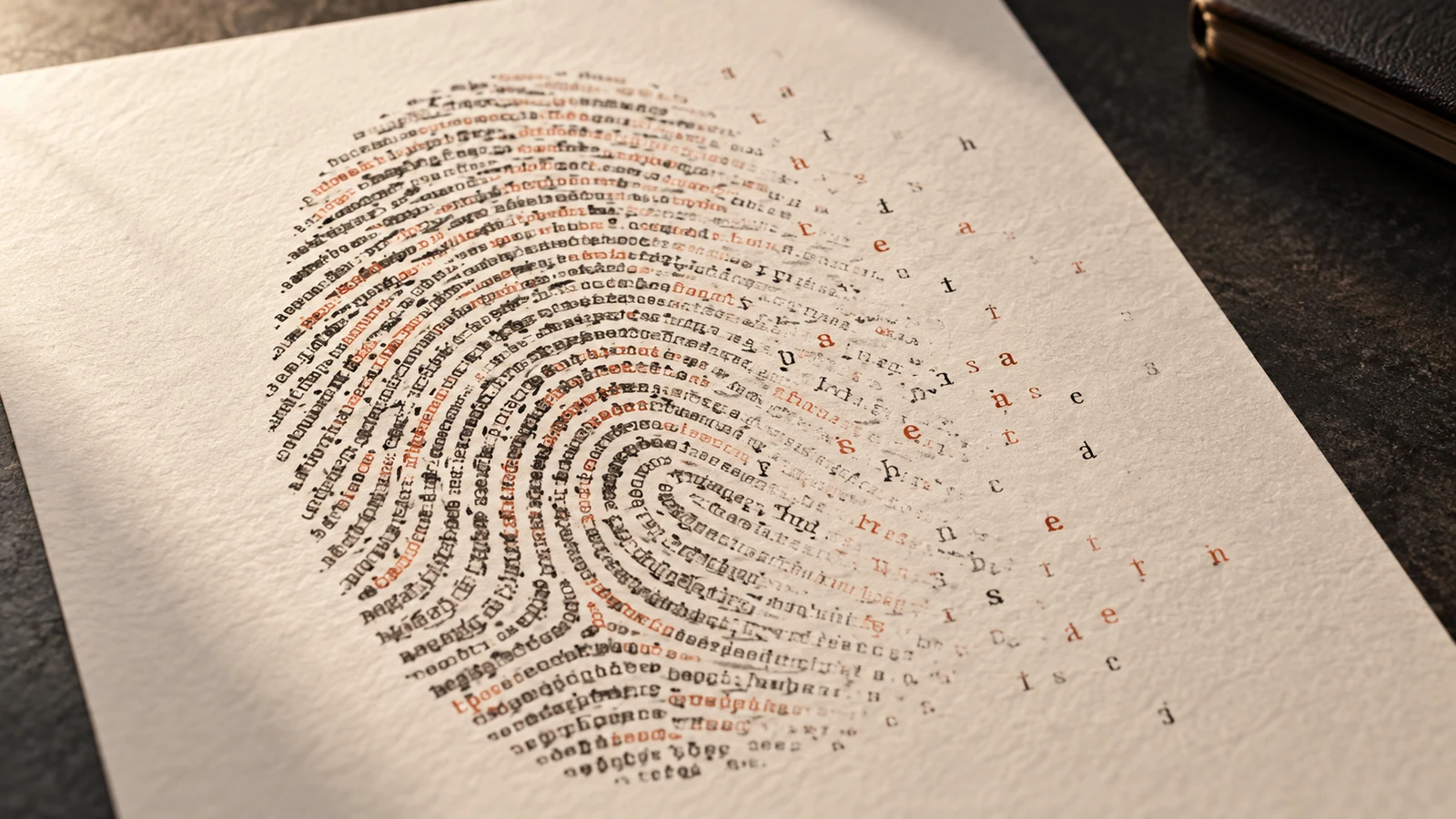
The announced marking of OpenAI-generated text in the EU brings up strong feelings for me. I understand the need for transparency, but I wonder whether a detected mark will be interpreted carefully enough. Especially when AI helps a person rather than replaces them as a writer.
What OpenAI announced and where the mark will appear
In its 5 October 2026 announcement, OpenAI says watermarks will cover eligible ChatGPT and Codex text in the EU over the coming weeks. API customers can opt in globally for selected models; the default is off.
The OpenAI Help Center explains that textGrain alters statistical word-choice patterns, without adding hidden characters. A matching detector looks for this signal. It is not a judgment that the writing style “sounds like AI.”
Will this actually solve AI detection?
I do not think it will be a universal solution. A signal like this may help, but I do not expect it to settle the entire problem of recognising AI text. My biggest concern is how confidently people will interpret a limited result.
OpenAI acknowledges that substantial rewriting or translation can make a watermark undetectable. That is not guaranteed signal removal. It also limits detector access to approved research and academic organisations.
In the test reported by OpenAI on 400-token English answers from the ELI5 dataset, detection fell from about 92% to 66% after 10% of words were replaced with synonyms. Replacing 25% brought it to 17%. These are results from one experiment, not detection rates for every kind of text.
That limitation matters to me. If the absence of a mark does not settle the question, and detecting it still requires interpretation, I do not want a simple rule that says a marked text is worthless while an unmarked one must have been written entirely by a person.
Writing assistance should not erase the author
I am thinking of an ordinary writing process. A person has their own experiences and opinions, prepares a text, gets help with translation or proofreading, then changes it substantially. One label does not tell the whole story of how that article came together.
OpenAI itself cautions that detection does not establish authorship or measure human contribution. I want that caution to survive outside the documentation. Readers should be able to assess the arguments, the author’s experience and the quality of the text, without reducing everything to one label.
What if someone treats a detector as proof?
Schools are one of my main concerns. Could students be wrongly accused of using AI because of a detector result? Could someone confuse watermark detection with tools that try to guess from writing style? These are my questions about possible misuse, not confirmed incidents involving this new system.
A similar style alone does not prove a watermark is present. Still, I would not want that technical distinction to disappear in practice, leaving a student to prove their innocence just because a text was flagged. A tool’s result should start a discussion about context, rather than end it.
What happens when AI helps with almost everything online?
What if a huge share of the internet eventually contains this signal? Imagine even 90 percent, as a hypothetical scenario rather than a current statistic. Would a watermark still tell readers something useful, or would it become another label people stop noticing?
I do not yet know how people will use this technology. I hope it helps us understand where texts come from, but I worry about oversimplification. We will see the answer in practice, in schools, newsrooms and everyday reading. Introducing a watermark does not close those questions.